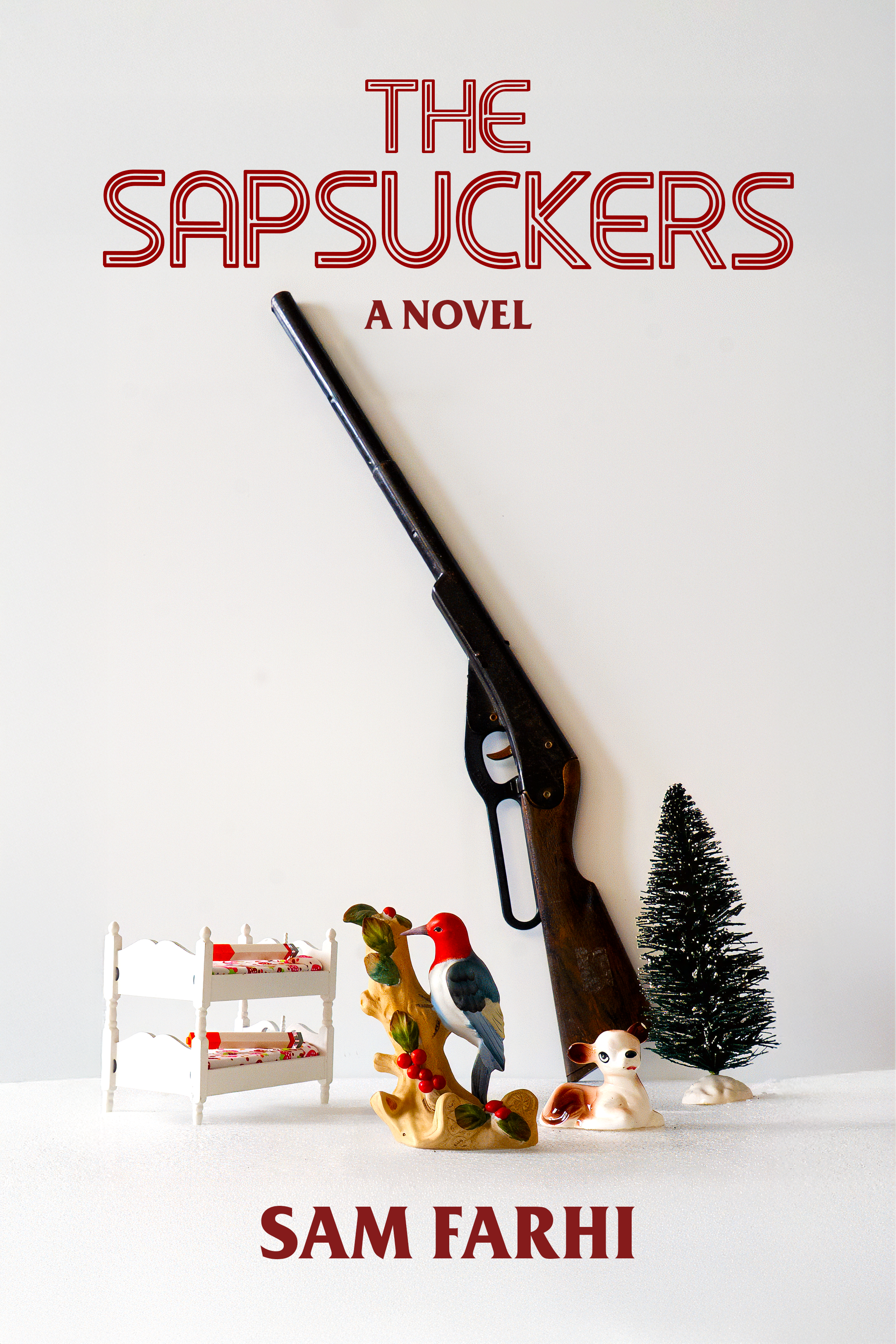
The Sapsuckers
a novel
by Sam Farhi
Coming August, 2026 from Spuyten Duyvil Press
“Don’t tell mom.” Those were the last words Rem ever told his little brother Pete in the summer of 2004 before slipping out the door of their trailer with a half-filled backpack, disappearing into the night forever. Words that haunt Pete almost as much as the ones scrawled over Rem’s lifeless body when the police found him later, hanging by a gorge in the sleepy upstate college town of Ithaca, New York. The police declared it a suicide, but for Pete and his mother Peg, the truth is something both more complicated and more simple than that. The Sapsuckers is a literary anti-mystery suffused with slow dread, a compelling exploration of our obsession with true-crime, and a mesmerizing debut that probes the tenuous connection of bonds that are forged in trauma.
ADVANCE PRAISE FOR THE SAPSUCKERS:
"Sam Farhi’s writing in The Sapsuckers is hard and cracked as the bark of a North American White Oak, but the liquor that flows inside is clear and sweet. Peter is the young narrator trying to sound detached and adult, but under every word is his tender mourning for his older brother, Rem, who left him too soon. Only a younger brother could love and admire his older brother like that. This book does something only a few great novels have accomplished: to make every word mean two opposite things—two rival emotions—at once; to make every word count, double."
- Robert Antoni, author of As Flies to Whatless Boys, and Foreign Body
“Intense, raw, and haunting, The Sapsuckers takes on a young man’s obsessive search for the truth about his brother’s mysterious death. We travel down dark corridors and into the unexpected depths of a family’s history in this gripping and beautifully written debut novel.”
- Laura Sims, author of Looker and The Man
"In The Sapsuckers, Sam Farhi writes with a tactile intelligence that makes environment inseparable from thought. This is prose that does not merely describe place but saturates the reader in it, the slow creep of decay becomes felt conditions rather than metaphors. Farhi’s sentences move with a deliberate, unsettling grace. His work is oddly tender, bracingly unsentimental yet deeply alive. The Sapsuckers announces a writer unafraid of discomfort, one who understands that the richest truths often lie in the less obvious moments. A novel to be admired, which will still be with you long after you put it down."
- Thomas Moore, author of Forever and We'll Never Be Fragile Again
"A riveting, disquieting portrait of grief, alienation, brotherhood, and the particular strangeness of coming of age in an American college town at the dawn of this millennium. A world unto itself that is also, unmistakably, our world. I loved every sentence."
- David Leo Rice, author of The Berlin Wall and The Squimbop Condition
“Sam Farhi’s The Sapsuckers is so stylistically inventive one is almost surprised by the depths of its emotional resonance. From the outset, young Peter Dixon’s intimate recounting enmeshes the reader in his world of precarity, betrayal and pervasive threat. Close observation and keenly attuned dialogue give us characters who feel fully dimensional, yet their interactions play out in often unexpected ways. Throughout, the rupturing of linear narrative is sustained, intensified, and lent cohesion by the candor and unflinching honesty of Pete’s voice. This is an exceptionally well-conceived and finely crafted debut novel.”
- Eric Darton, author of Free City and Divided We Stand
"Haunting and slyly devastating, Sam Farhi’s The Sapsuckers unspools a palimpsest of voices as they write and rewrite the inexplicable, feeding off one another’s narratives like Farhi’s parasitic, yellow-bellied bird. Set amongst the trailer parks and rural wilderness surrounding Cornell University where Nabokov taught, Farhi brings some of the infamous Ithacan’s playful and slippery poetics to streets that are 'bright and wasteful.' Zig-zagging across time and space, Farhi disrupts chronology as we piece together fragments that carry a tragic inevitability akin to Lynch’s Fire Walk With Me. Astrological planets. Video games. An answerphone message left amongst hoax calls. Static like snow on a television screen. As Rem writes, 'I always thought there had to be an invisible world on the other side of things.'"
- Matthew Kinlin, author of So Tender a Killer